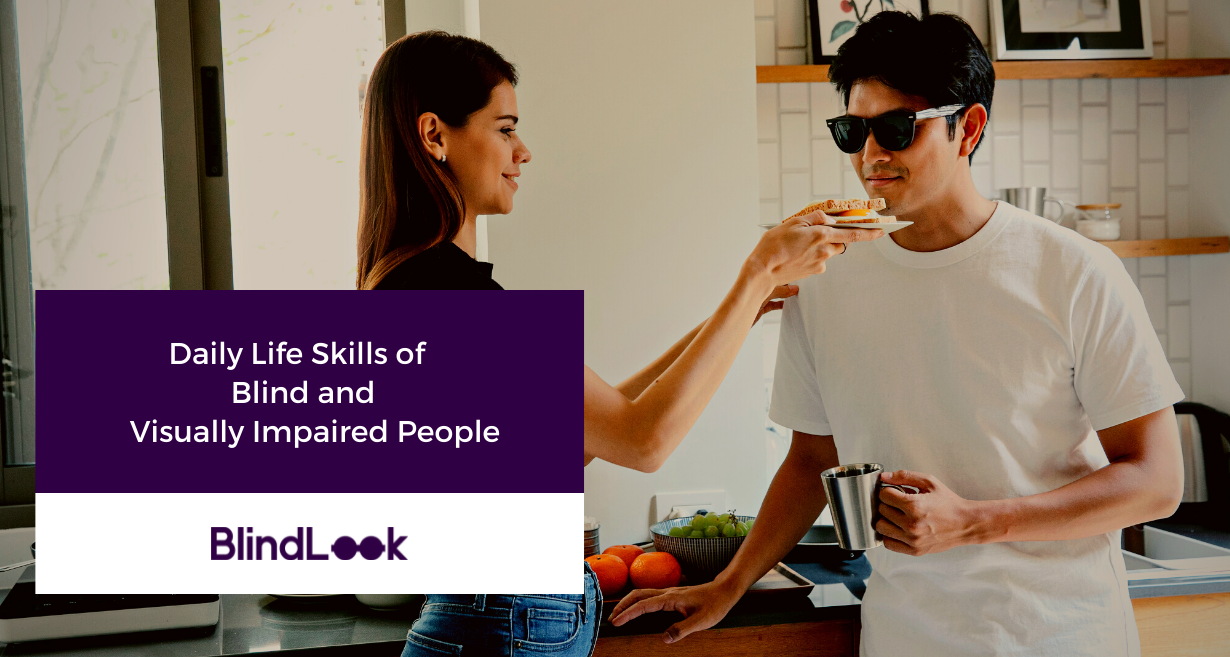
In our article, we will talk about the daily life skills of blind and visually impaired people. First, let’s begin our article by answering the question “what are daily life skills?”
What are daily life skills?
Daily life skills are skills that help everyone live a happy and efficient life. For example, brushing teeth, combing hair, shaving a beard, etc. can be counted as an example of these skills.
Now, let’s continue our article with questions about whether blind and visually impaired people can perform daily life skills or not.
Can blind and visually impaired people perform daily life skills? How do they learn to perform daily life skills? How do blind and visually impaired people perform daily life skills such as brushing teeth, combing hair, getting a beard shave, eating etc? How do blind and visually impaired people learn basic life skills?
These questions are one of the most frequently asked questions of the people who encounter blind and visually impaired people.
Because blind and visually impaired people cannot learn daily life skills by imitating sighted people, their close ones should teach them these skills. If their close ones didn’t teach them these skills, then they can learn them by getting training from a rehabilitation center. Not having these skills affects the person’s life negatively and causes the person to not be able to integrate into society.
Now, let’s take a look at how do blind and visually impaired people perform some of their daily life skills:
How do blind and visually impaired people eat?
The question “how do you eat?” is asked by especially small children to blind and visually impaired people.
For example, if a blind and visually impaired person drinks a soup from a bowl, he puts the spoon into the bowl, then he gets the soup by dragging the spoon into the bowl and he drinks the soup by getting the spoon into his mouth.
So, how can a blind and visually impaired person know whether there is soup in the spoon or not?
Because a blind and visually impaired person can’t see inside the spoon, the fact that the spoon is heavier than usual means that it is full. If the spoon is at its usual weight, then it means it is empty. If a blind and visually impaired person is going to eat with a fork, he finds where the food is by navigating the fork inside the plate and he gets the food by stabbing the food to the fork. Again, whether there is food in the fork depends oft the weight of the fork.
How do blind and visually impaired people find their mouths while eating?
While eating, sighted people can’t see their mouths, too. They know where their mouth is while eating and take the fork or the spoon to their mouth according to that. Because blind and visually impaired people know their bodies in the same way, they have no trouble taking food to their mouths. A blind and visually impaired person can eat like this.
How do blind and visually impaired people brush their teeth?
While brushing his teeth, a blind or visually impaired person first washes his hand, and he has torub the paste into the brush. To do this, he touches the paste with the brush and by slightly squeezingthe paste, he places the paste onto the brush. Once the paste is rubbed into the brush, the blind and visually impaired person takes the brush to his mouth and brushes his teeth.
How does a blind or visually impaired person comb his hair?
A blind and visually impaired person can comb his hair with a hair comb as a sighted person does. However, as he can’t see how his hair looks from the mirror, he can understand by touching if his hair is proper or not.
How do blind and visually impaired people shave their beards?
Blind and visually impaired people, just like sighted people, can shave their beard with a razor blade or a shaver. The person first understands where his beard is by touching, and then he shaves his beard by rubbing the shaver or the razor blade to that area. If the razor blade is going to be used for shaving, care should be taken not to rub the razor blade somewhere else except the beard or the moustache, because this can cause the person to be injured. After blind and visually impaired person finishes shaving, he can understand whether it is properly shaved by touching his beard or moustache. If there is any area that is unshaved, he can shave that area and complete hisshaving.
So, if a blind and visually impaired person can’t imitate other people by seeing them, how does he learn to use the daily life skills?
A blind and visually impaired person can learn daily life skills at a young age when the person’s parents or close ones teach him. To show a gesture to a person, the close one can hold his hand and can make him do that gesture. Thus, a blind and visually impaired person learns what to do.
If the age of the person has grown and he couldn’t learn the daily life skills, then he can consult the rehabilitation centers. In these rehabilitation centers, trainers can give education in subjects that are related to blindness and visual impairment, such as daily life skills, using a white cane, braille literacy, etc., and help the person integrate into society.
What happens when families don’t take care of their blind and visually impaired children’s daily life skills at a young age?
A blind and visually impaired person who didn’t learn daily life skills can’t integrate into society. For example, if the person hasn’t learned to comb his hair, then he can look bad in society, and this can cause him to be excluded. Because usually the people don’t tell each other about their flaws in their appearance for the sake of kindness, it can be too late when the person understands this. Therefore, it should be tried to teach daily life and self-care skills to blind and visually impaired people as early as possible and it should be told to the people in a realistic manner what consequences await them in the case that they don’t perform these skills.
In our article, we tried to talk about how blind and visually impaired people perform some daily life skills, how they learn them, and what can happen if they don’t learn these skills. As BlindLook, our aim is to ensure that all blind and visually impaired people participate in society as people who can perform daily life and self-care skills freely and confidently.
Author: Fatih Yüksek / BlindLook Team