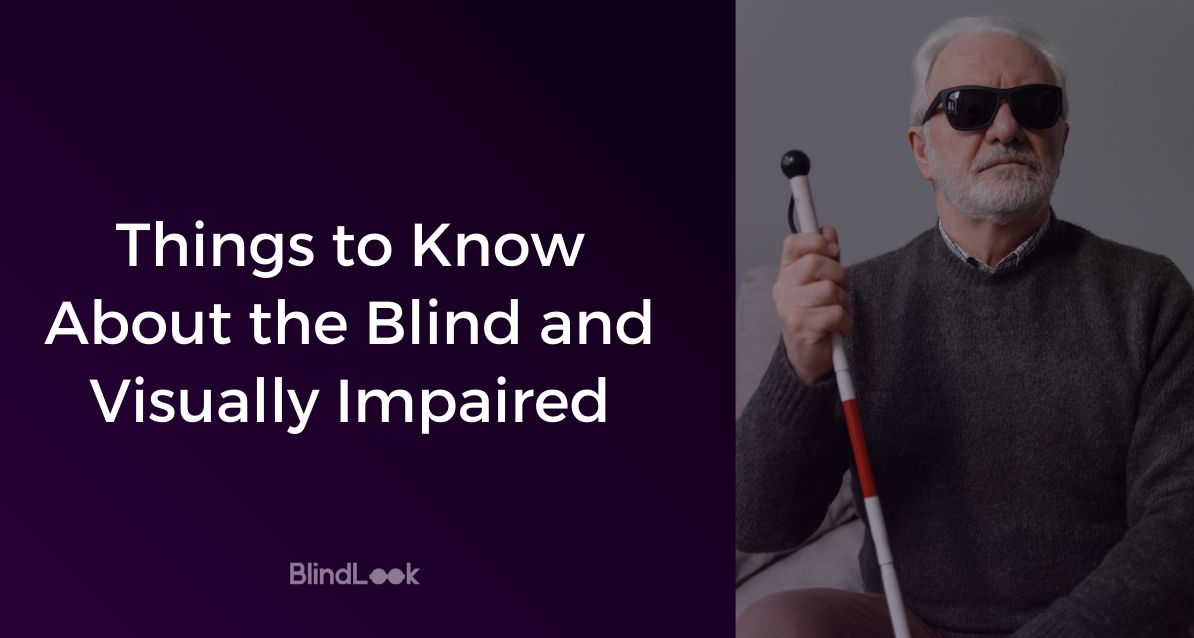
In this article we will talk about common misconceptions about blind and visually impaired people and blindness. Being informed about this subject can help you communicate with a blind and visually impaired person easier, or this can satisfy your curiosity about blindness and visual impairment.
In this article, we will together search for answers for questions like “Can blind and visually impaired people read or write?” “Do blind and visually impaired people dream?” “Do blind and visually impaired people understand how someone looks by touching them?” “Can the word ‘to see’ be used while talking to a blind and visually impaired person?” “Are the employment options for blind and visually impaired people very limited?” “Can blind and visually impaired people perform self-care and live alone?” “Does being blind and visually impaired mean not being able to see anything at all?” “Do all blind and visually impaired people have guide dogs?” “Do all blind and visually impaired people look for a cure for their blindness or visual impairment?”
If you are ready, let’s begin…
Can blind and visually impaired people walk in the street on their own?
Blind or visually impaired people can walk in the street on their own with the aid of a white cane or a guide dog without getting help from anyone.” When they lose their way, they can use the navigation apps which are installed on their phones, or they can ask someone to show them the way in the street.
It should be noted that for the blind and visually impaired individual and his family, walking on the road on his own is a hard and bold process in the beginning. When a blind and the visually impaired person starts to walk on the street on his own, questions like “What if I get lost?” “Will a car hit me while I cross the road?” might appear in his head. For this reason, blind and visually impaired people usually go out on their own later than sighted people. When they finally go out on their own, their confidence increases, and they feel happy.
Maybe you ask, “why is walking on their own in the street more difficult for blind and visually impaired people?”
I can explain the answer to this question by giving you an example:
Imagine that you can’t see in front of you, and you have only a white cane to check what is on the ground. You are walking in the street, and you don’t know where to go, you are suddenly lost, it’s all empty around you and there is no one to ask the way.
This feeling could be one of the thoughts of a blind or visually impaired person who is just beginning to go out on his own. But when the person sees that everywhere isn’t empty and there are people who can help if he gets lost, he will feel more relaxed and he can go to places on his own, where previously he had to ask the way or ask for help.
The parents of blind and visually impaired children, in a desire to protect them from danger, take them everywhere themselves, because they often worry, thinking “what if a car hits my child on the road or something bad happens to him?”
Going out on the street on his own is a process that needs to start in the mind of a blind and visually impaired person. If he can prove, both to himself and to his parents, that he can go out on his own, his self-confidence will increase, and his parents will feel more relaxed.
Can blind and visually impaired people read or write?
Of course, blind and visually impaired people can read and write, but because they can’t see, they can’t read the Latin alphabet. Instead, they use an alphabet called the Braille alphabet which is written using six dots for reading and writing.
However, unfortunately, the Braille alphabet is not used widely in our country (Turkey), but blind and visually impaired children can get their study books in Braille format starting from elementary school to high school. Also, practices like the buttons of the lifts are written in Braille, and names and dosages of the medicines are written in braille are available.
Examples like these are proof of how important it is for a blind and visually impaired child to learn Braille.
Printing books with the Braille alphabet (embossing) is a high-cost process. Braille books are larger and heavier than normal books, so they can’t be carried around as easily as normal books.
Writing in Braille is accomplished by either a tool called the slate or typewriters which are manufactured especially for blind and visually impaired people (brailler.)
Can blind and visually impaired people use computers?
Blind and visually impaired people use the computer with a program called a screen reader which converts what is on the screen to speech.
Except for this program, the computer that they use is a normal computer. They just install a screen reader program like installing any other program. This program helps the blind and visually impaired person in performing the actions that could be performed on a computer such as surfing the internet, reading books, watching videos, reading and composing e-mails by converting what is on the screen to speech.
Blind and visually impaired people also can prefer listening to the books on their computer rather than reading or writing with Braille. They can even use the computer for education.
Do blind and visually impaired people dream?
Yes, they can. Since dreaming is a process of the brain that blends what is experienced in the day to show it in the night and since blind and visually impaired people can’t see, they experience the dream by hearing and feeling the objects around them.
That is to say, if there is a forest in the dream and for example, if the blind and visually impaired person is trying to get some fruit from a tree, he feels that he is walking towards the tree, climbing the tree and ripping the fruit from the tree by finding it with his hand. He hears the sounds of the birds in the forest and feels the smell of the fruits.
Do blind and visually impaired people understand how someone looks by touching them?
Blind and visually impaired people can’t understand how someone looks visually. Touching and seeing aren’t the same things. Even though blind and visually impaired people detect many things by touching because they can’t see, this doesn’t apply to people, as someone who is touched without permission feels himself/herself uneasy.
Even, for example, someone who is blind from birth can’t fully visualize the concepts like blond or blue eyes, because colors can only be seen with the eyes, and for a person that hasn’t seen anything since birth, it is very difficult for him to visualize these in his mind, for this person, colors are only, unfortunately, words must be memorized, because if a blind and visually impaired person does not know which color suits which color and if he is alone, then he might mismatch his clothing and this can cause the person to look bad within the community.
So, even though a blind and visually impaired can’t see any colors, he should know which colors the suit which color, so he can choose his clothing accordingly or if he doesn’t know, it would be better if he asks a sighted person then acting on his own and makes an unsuitable choice.
Can the word “to see” be used while talking to a blind and visually impaired person?
Yes, it can be used. Even blind and visually impaired people use this word because they got used to it. For example, “I read a book”, “I’m happy to see you” or “see you.”,
To give a simple example, sentences like “I listened to a book”, “I’m happy to hear you” might sound weird. To use the word “to see” saves the blind and visually impaired person from every time replacing that word with another word and makes the communication easier, so you can use this word comfortably.
Are the employment options for blind and visually impaired people very limited?
Blind and visually impaired people can do jobs like lawyer, programming, psychologist, musician, massage, teacher, translator, and many more. However, they can’t do jobs where vision plays an important role, for example, soldier, police, driver, construction worker, etc.
Can blind and visually impaired people perform self-care and live alone?
Blind and visually impaired people can live independently from their families. However, this is possible after a long process of education as blind and visually impaired people can’t perform an action as a sighted person does by seeing and imitating someone, so they have the self-care and independent living skills from the rehabilitation centers and in this way, they can live alone and without help from anyone.
Does being blind and visually impaired mean not being able to see anything at all?
No, being blind and visually impaired doesn’t mean not seeing anything at all. There are people who have limited vision. They are called “people with low vision”.
Do all blind and visually impaired people have guide dogs?
No, not all blind and visually impaired people have guide dogs. This has a few reasons:
1- A blind and the visually impaired person might not want to care for an animal.
2- Having a guide dog is a long and complicated process. A guide dog also has a life, like another dog, it wants attention, play, and feeding.
3- In some countries, guide dogs might not be accepted into public transport vehicles or flights, and this can be problematic for the person.
Most blind and visually impaired people use a white cane due to the reasons stated above. Do all blind and visually impaired people look for a cure for their blindness or visual impairment?
When the child is diagnosed with visual impairment for the first time, parents naturally feel confused and shocked. As a result, they look for a cure from the doctors. Even though if they want to, they can consult alternative medicine and other methods, sooner or later they have to accept that there is no cure for the child.
If they don’t accept, life becomes harder for the child, and as a result of the unaccepting attitude of their parents, children, in some cases, might not be wanted by their relatives or be hidden by their families.
A child who has been subjected to this kind of treatment can cling to life only with his will and achieve some things. If he too doesn’t accept his visual impairment, life could turn into a living hell for him/her.
Unfortunately, currently, there is no medical remedy for visual impairment, and the only thing to do for the blind and visually impaired person is to accept his condition and learn to live with it.
Our aim as BlindLook is to develop technologies to help blind and visually impaired people in this journey of life and to cooperate with the brands that develop products that everyone uses every day for this purpose.
Author: Fatih Yüksek / BlindLook Team