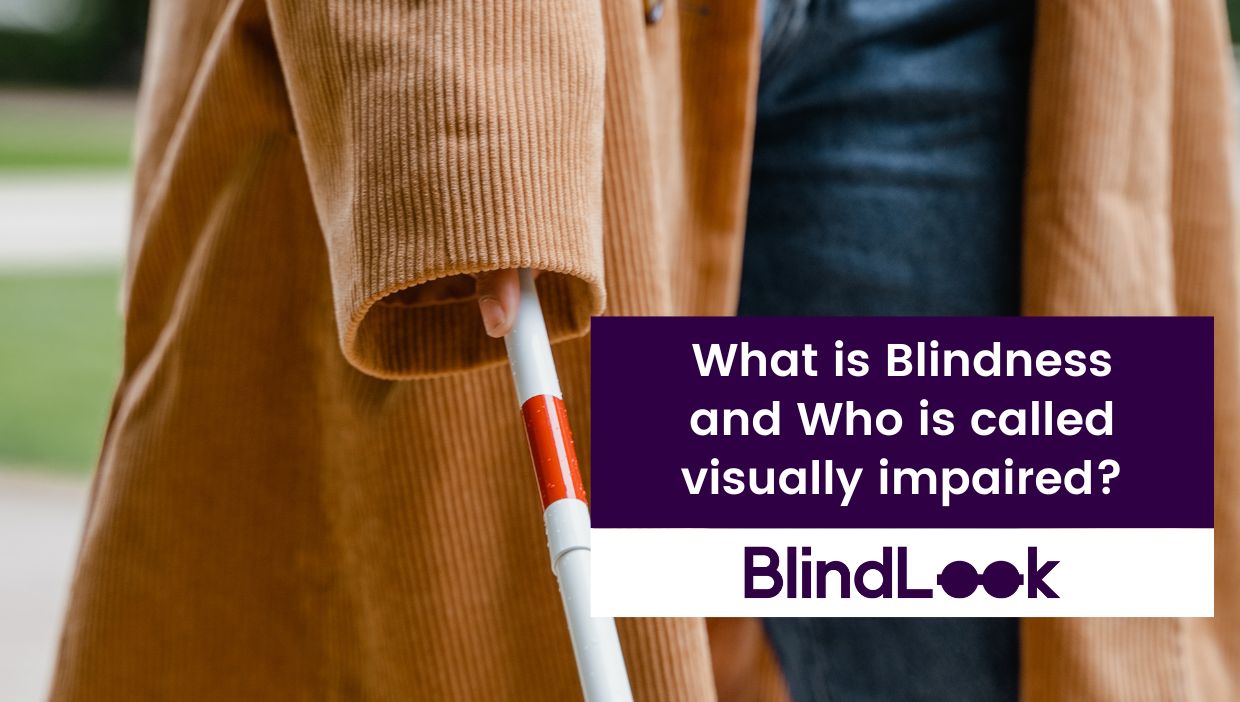
As we start our article, let's first try to answer the question of who is called visually impaired.
Who is considered blind, or visually impaired?
People who have significant losses in their vision, where a medical examination reveals a 40% or more loss of vision, are considered to be visually impaired or blind.
So, are only people with over 40% vision loss characterized as visually impaired?
When we're discussing visual impairment, it's essential to differentiate between totally blind individuals and those with low vision. These two groups have distinct categories, and health and physical assessments are made accordingly.
What is total blindness, and who is considered totally blind?
If someone is referred to as totally blind, they should have complete blindness, meaning they do not see at all, and the disability rating should be 85% or higher. In short, totally blind individuals are those who have lost their ability to see entirely, either from birth or later in life. These individuals use various aids like Braille, screen-reading software, and specially designed digital devices to accomplish daily tasks. Totally blind individuals can lead independent lives, utilizing evolving technology in education, work, and personal life, as previously mentioned.
You can use this link to see how visually impaired people benefit from technology and read articles written on the subject.
So how many visually impaired people are there in the world?
According to the figures announced by the World Health Organization (WHO) in 2020, 285 million people in the world are currently visually impaired. While this number was 216 million in early 2000, it increased to 285 million in 2010 and beyond. 285 million visually impaired people include people whose vision loss can be reported with a doctor's approval. When we consider that there are people who do not have their vision loss determined by a doctor's report, this number is likely to increase.
Now, let's address low vision. What is low vision, and what are the conditions associated with it?
Individuals with low vision are individuals who have not completely lost their vision compared to the total visually impaired, but who experience vision loss at certain rates. People with low vision can increase their vision to some extent by using technology.
Using a magnifying glass while reading a book, making use of large visuals while trying to perceive colors and preferring large texts while reading text are just a few of the methods used by individuals with low vision.
Low vision can encompass a variety of conditions, including Retinitis Pigmentosa, Diabetic Retinopathy, and Glaucoma.
We can list them as Retinitis Pigmentosa, Diabetic Retinopathy and Glaucoma.
What is nyctalopia (Retinitis Pigmentosa) disease?
Retinitis Pigmentosa, known as nyctalopia, is characterized by the inability to see clearly in low light, especially at night. While it is often identified in childhood, it can occur at any age. People with this disease do not have the same degree of vision loss. While some patients gradually lose their vision at an early age, others have enough vision to sustain themselves throughout their lives. Only after a doctor's check-up can the exact loss and stage of progression be understood.
Retinitis Pigmentosa does not cause vision loss at the same rate in everyone, nor does it leave the same effects in everyone. While some patients go through this stage as night blindness, some patients can see better at night and experience vision loss during the day. However, since the disease has a night blindness effect to a great extent, it is popularly referred to as night blindness. You can visit the link for detailed information about Retinitis Pigmentosa.
What is Diabetic Retinopathy? How does it affect vision?
Diabetes is a disease that causes glaucoma, inflammation of the optic nerve, paralysis of the eye muscles as well as various damage to the retina, leading to vision loss. Diabetic Retinopathy is the leading cause of vision loss. In some people with diabetes, the aforementioned conditions such as visual nerve disorders and eye paralysis are also triggered and vision loss occurs over time. You can find more information about Diabetic Retinopathy from the link.
What is glaucoma?
Glaucoma, also known as the "silent thief of sight," is a common eye disease that typically presents no symptoms until it has already caused significant damage. The disease progresses silently and often goes unnoticed without a comprehensive eye examination. If left untreated, glaucoma can result in permanent vision loss.
What are the symptoms of glaucoma?
Symptoms of glaucoma are not always obvious, as mentioned above. Some individuals may experience occasional blurred vision, seeing light rings around lights at night, or eye discomfort when watching TV. These can be considered as potential symptoms of glaucoma.
How is glaucoma treated?
Glaucoma is a disease that has fewer effects the earlier it is recognized. It cannot be completely eliminated, but depending on the progression of the disease and the start of treatment, vision loss can be prevented, albeit slightly. You can get more detailed information about glaucoma from the link.
Some of the types of diseases that cause low vision listed above can be corrected with some treatment methods and vision loss can be minimized.
In this respect, we should say that the ability to increase the vision of individuals with low vision should be evaluated according to the disease they are suffering from. What can cause visual impairment? Total visual impairment and low vision, which we have discussed above, can be caused by many factors both during and after birth. Febrile illnesses during pregnancy, exposure of the child to X-rays during pregnancy, the use of certain medications by the mother before pregnancy, and excessive oxygen to the baby in the incubator are just a few of these causes. Apart from this, the child's having certain accidents after birth, experiencing vision loss by having different diseases can also be shown as examples for these reasons. In this article, we have examined who is called visually impaired, the concept of visual disability and different areas of the concept. You can get more detailed information about the concepts we mentioned in our article by using the relevant links.
Author: Kadir Ahıska / BlindLook Team